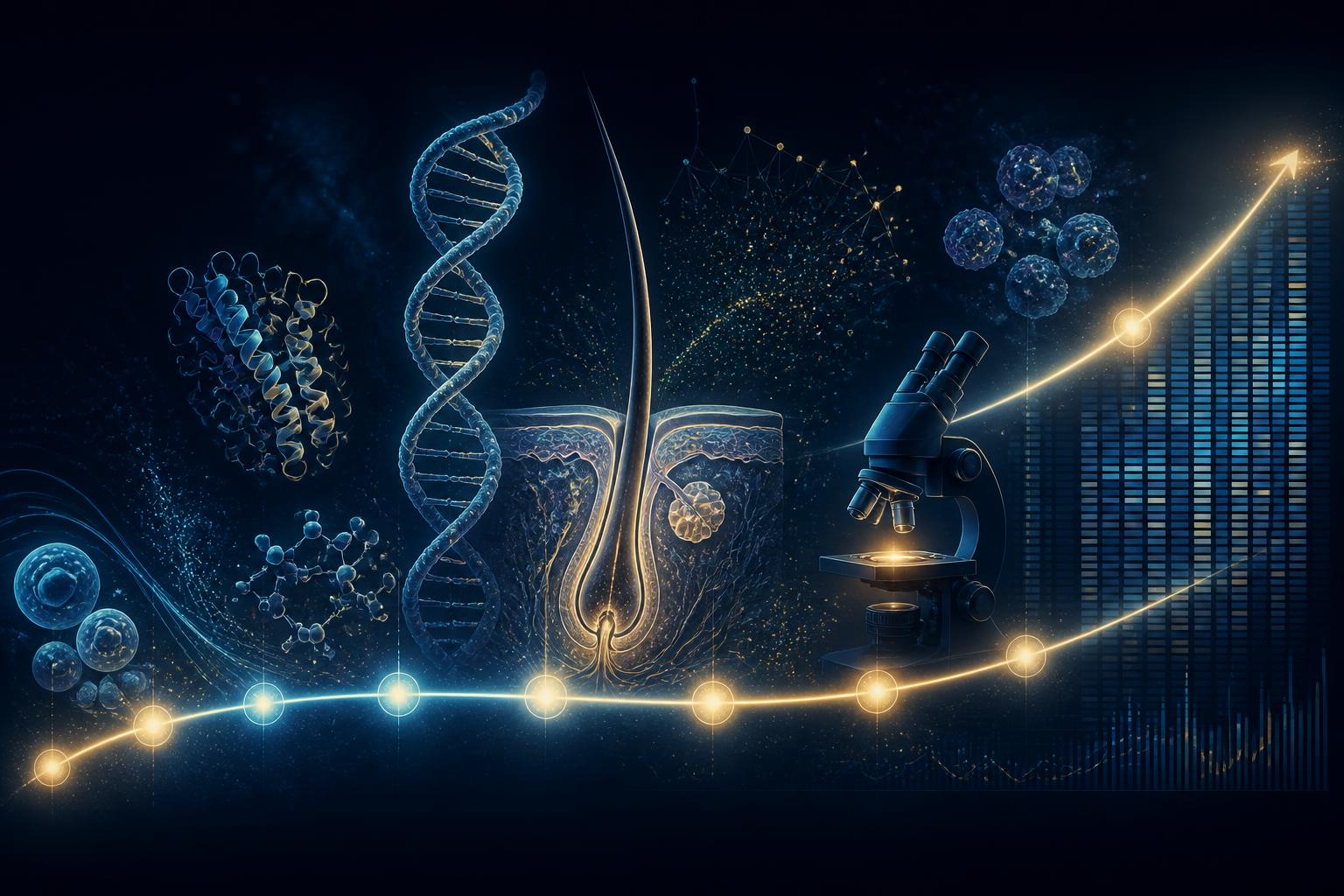
Continuum's scientific program traces an unbroken chronological arc from 2002 to the present. It opens with the first peer-reviewed randomized, double-blind, placebo-controlled trial to demonstrate efficacy of botanically derived 5-alpha-reductase inhibitors in androgenetic alopecia (Prager, Bickett, French & Marcovici, Journal of Alternative and Complementary Medicine, 2002) — establishing, for the first time, Level-1 clinical evidence for a mechanism-based natural therapy that would seed an entire product category.
Nine years later, in collaboration with the State University of New York's Center for Functional Genomics, that program advanced to whole-genome transcriptomic profiling in human keratinocytes, showing suppression of LPS-activated chemokine and cytokine signaling (Chittur, Parr & Marcovici, Evidence-Based Complementary & Alternative Medicine, 2011) — reframing androgenetic alopecia as, in part, an inflammatory follicular disease.
In 2016, work undertaken with collaborators at the University of Chicago extended these findings into matched dermal-papilla and LNCaP prostate cell assays, where a defined multi-component botanical composition down-regulated androgen-axis biomarkers and outperformed finasteride on those endpoints (Marcovici et al., Phytotherapy Research, 2016).
Four years on, in partnership with Bauman Medical, the program translated this molecular foundation into a nanotechnology-enabled β-cyclodextrin inclusion-complex delivery system — the first reported clinical use of nano-inclusion chemistry to follicularly target a multi-active botanical regimen in androgenetic alopecia (Marcovici & Bauman, Cosmetics, 2020).
Most recently, in joint work with CryoConcepts LP, that nano-botanical platform has been amplified with cryo-chilled, transdermal CO₂ delivery, compressing prior 9-month phenotypic reversal timelines into 90 days even in advanced-stage, historically refractory phenotypes (Niedbala, Campbell, Young & Marcovici, Journal of Complementary Research and Alternative Medicine, 2025).
Across all five landmarks, the work has been conducted in active partnership with university-based investigators and academic medical centers — SUNY's Center for Functional Genomics, the University of Chicago, Columbia University, Bauman Medical, and CryoConcepts LP — coupling industry-driven hypothesis generation with rigorous, independent academic execution.