Continuum
Innovative
Life Sciences Division

Provisional Deep-Dive

Senescence Biology

Keeping aging follicles capable of regrowth
Abstract microscopy image of aging follicular cells regaining regenerative competence
USPTO Provisional 64/073,264

Aging follicles don't just miniaturize — they lose the ability to regenerate. This filing addresses both.

Back to Intellectual Property

In brief

As people age, the cells inside each follicle quietly slip into a worn-out state called senescence long before the hair itself visibly thins. Once enough follicles enter this state, no amount of hormone blockade will bring the hair back — the follicle has simply lost its capacity to regenerate. This filing covers the compositions and protocols that preserve regenerative capacity in follicles that are starting to age, and that restore it in follicles where regeneration has already begun to fail.

For an international commercialization partner, this addresses the segment that classic hair-loss products consistently underserve: middle-aged and older customers who have been told 'there's nothing more we can do.' It is the scientific basis for a longevity- and healthy-aging-positioned product line — a fast-growing and premium-priced category — that can be carried alongside, rather than replacing, standard androgen-focused offerings.

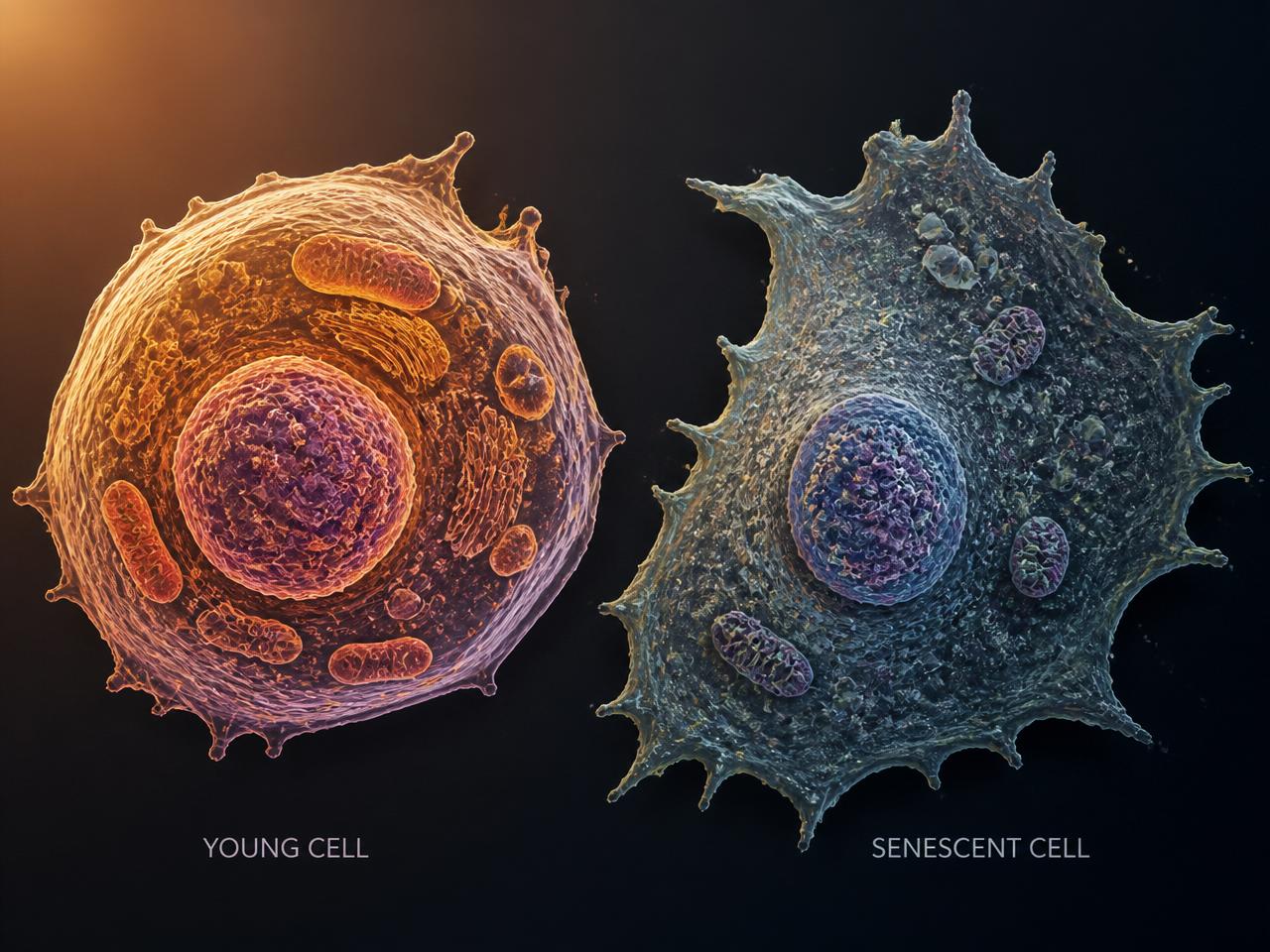
What cellular senescence actually is

Illustration contrasting a vibrant youthful cell with a senescent, dimmer cell
Senescence isn't death — it's a cell that's still alive, but no longer responding to normal growth signals.

Senescence is not the same as cell death. A senescent cell is alive, still metabolically active, and still occupying space in the tissue — but it has permanently stopped dividing, and it has stopped responding normally to the signals that would ordinarily push it to grow or regenerate. Worse, senescent cells secrete a chronic mixture of inflammatory and remodeling signals that gradually degrade the tissue around them.

In the last decade, senescence has emerged as one of the most important drivers of aging biology across every tissue that has been studied — skin, muscle, brain, joints, and hair. It is a foundational aging mechanism, not a hair-specific quirk.


Why aging follicles stop responding to treatment

Illustration of a follicular stem-cell niche with quiescent, exhausted stem cells
When the follicle's stem-cell reserve enters senescence, the drug has nothing left to act on.

A follicle's ability to grow a hair depends on a small population of stem cells that can be called on, cycle after cycle, to rebuild the growing structure. When those stem cells enter senescence, the follicle can still exist — it just can no longer regenerate. This is why standard hair-loss treatments frequently fail in older patients: the drug can be doing its job, but there is no responsive stem-cell population left for it to act on.

This is also why patients over a certain age are so often told there is nothing more to do. It is not that the treatments are wrong — it is that they were designed for a follicle that still has regenerative competence, and that assumption breaks down with age.

What this provisional protects

Illustration of a previously dim cell regaining metabolic activity and molecular signaling
Restoring regenerative competence — working on the reason older follicles stop responding, not just the symptom.

The filing covers compositions and application protocols designed to preserve regenerative competence in aging follicles that have not yet lost it, and to restore it in follicles where the stem-cell population is entering senescence. The intervention targets the specific cellular state — not just the hair-growth signal — which means it works on the reason older follicles stop responding, not only on the symptom.

The mechanism sits inside the broader longevity science category, but it is applied here to a tissue and a customer complaint where the payoff is visible and measurable in months, not years.

Why it matters commercially

The longevity and healthy-aging category is one of the fastest-growing segments in modern retail wellness, and it is priced at a premium consumers accept because the underlying science is credible and the outcome is personally meaningful. A hair product grounded in senescence biology sits naturally inside that category, appeals to a demographic every existing hair-loss line struggles with, and slots onto the shelf next to other longevity actives rather than competing head-on with commodity DHT-focused products.

  • Cellular senescence
  • Regenerative competence
  • Follicular aging
Contact